

If you employ people in Quebec, your prevention program or action plan now has to cover psychosocial risk, and for more establishments the deadline to have one in place was October 1, 2026. Here is what the law asks, who it applies to, and how to do the part most employers find hardest, which is working out what those risks actually are.
What is “Law 27”
“Law 27” is the common name for Bill 59, An Act to modernize the occupational health and safety regime. The National Assembly adopted it on September 30, 2021, and it was published as chapter 27 of Quebec’s 2021 statues, which is where the nickname comes from. In French you’ll see it as Lori27, LMRSST or PL 59. They all mean the same law.
It arrived in stages. Since October 2021, employers have had to protect workers’ psychological integrity, not only their physical safety, and to act when a worker is exposed to physical or psychological violence at work, including domestic, family, or sexual violence.
The permanent prevention regime took effect on October 1, 2025, replacing the interim one that had applied since 2021. The requirement that prevention documents cover psychosocial risks has applied since early October 2025. That’s the piece most employers are still catching up on.
Who has to do that
What you need depends on how many workers an establishment has. Every Quebec employer, whatever its size, has to identify psychosocial risks and act on them.
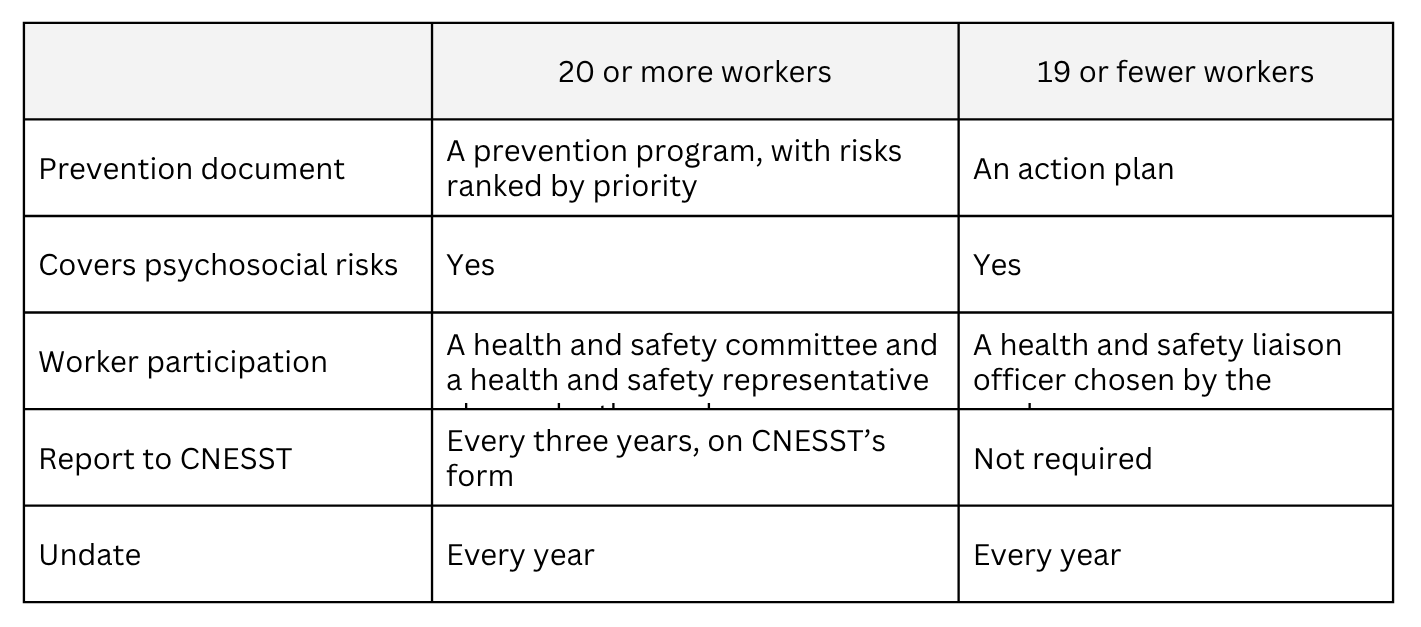
Both also need a policy on preventing and handling psychological harassment, and both cover employees who work from home.
Some employers fall outside the simple split. A small establishment covered by a program that spans several establishments follows the program rules, some sectors already had to run prevention programs before the reform, and the CNESST can require a program from any employer it chooses. If any of that might be you, check with the CNESST.
The deadline
For most establishments that existed on October 1, 2025, the prevention program or action plan was due by October 1, 2026. The general rule is one year from the day an employer becomes subject to the obligation so a business that opens or crosses 20 workers later gets its own clock.
If you’re past the date with nothing on paper, start now and date everything you do. An employer that can show where it began, what it found and what it changed is in a far better position than one that can show nothing. For what your specific gap means legally, talk to an occupational health and safety advisor or an employment lawyer.
What counts as a psychosocial risk
The CNESST describes psychosocial risk as situations tied to the nature and organization of work. They are about the job, not about a worker’s personality or resilience. That framing matters, because it points the fix at the work rather than a person.
It puts three risks first: violence, harassment, and exposure to a potentially traumatic event. Behind those, it names five risk factors that shape how heavy the work feels day to day:
Workload
Decision-making autonomy, meaning how much say people have over their own work
Social support from colleagues and managers
Recognition
Organizational justice, meaning whether decisions are made fairly
If you’ve read about Canada’s national standard, CSA Z1003, these will look familiar. Its 13 workplace factors cover the same ground in more detail. Our plain guide to ISO 45003 and CSA Z1003 walks through them.
How to identify the risks
The CNESST’s method has four parts: identify the risks, analyze them to decide which come first, eliminate them at the source or reduce them, then check that your measures keep working.
Identification is where most employers stall, because nobody files a report saying “workload too high”. Here is how to find what’s there.
Start with records you already keep. Absence patterns, turnover, incident and accident logs, and complaints often show where pressure is building. A team with rising sick days and two resignations in a quarter is telling you something.
Ask the people closest to the work. Your health and safety committee, representative or liaison officer, HR and supervisors usually know where conflict and incivility sit long before it reaches a formal complaint.
Aks workers directly. Interviews or a questionnaire fills the gaps. The CNESST recommends tools that are valid and reliable, that protect confidentiality, and, if trust is low, run by someone outside the organization.
Watch periods of change. Restructuring, new systems, leadership changes and staff shortages raise risk quickly. So do visible shifts in a team’s behaviours, such as withdrawal irritability or more time off.
Rank what you find. The CNESST suggests weighing how many people are affected, how serious the harm could be, how likely and frequent the exposure is, and what workers themselves say matters most.
Fix the work first. A risk that comes from workload is solved by changing the workload, not by a stress management session. Support for individuals still matters, it just comes after changes to the cause of the stress itself.
What to write down
If an inspector asks, your documents are your answer. For each psychosocial risk keep a record of:
What you found, how you found it, and when
How you ranked it against your other risks
What you’re changing, who owns it, and by when
How you’ll check the change worked, and what the check showed
How workers and and their representative, committee or liaison officer took part
Update the program or plan every year, and sooner when something changes the picture, such as a restructuring or a serious incident. If you have 20 or more workers, the repost you send the CNESST every three years draws on the same records, so keeping them current saves work later.
Free help
You don't have to do this alone, or pay for it. The CNESST has psychological health advisors who can explain your obligations and run awareness sessions in your workplace on request, and it publishes tools for identifying and analyzing risks. Quebec’s public occupational health network also offers free help through santeautravail.qc.ca.
This article explains the law in general terms and isn't legal advice. For your situation, check with the CNESST or a lawyer.
____________________________________________________________________________
PRA-Pulse™ gives you a structured place to start these steps. The free Risk Profile takes HR through a short set of questions every two weeks and shows how your organization trends, so you can see whether the changes you make move the next cycle. Each cycle is dated, which is the record a prevention program needs. It doesn't replace asking your employees. When you're ready for that step, PRA-Pulse adds a short employee pulse every two weeks.
See the strain rise. Before it spikes.
Start with Risk Profile, free: Create your free workspace | PRA-Pulse™