
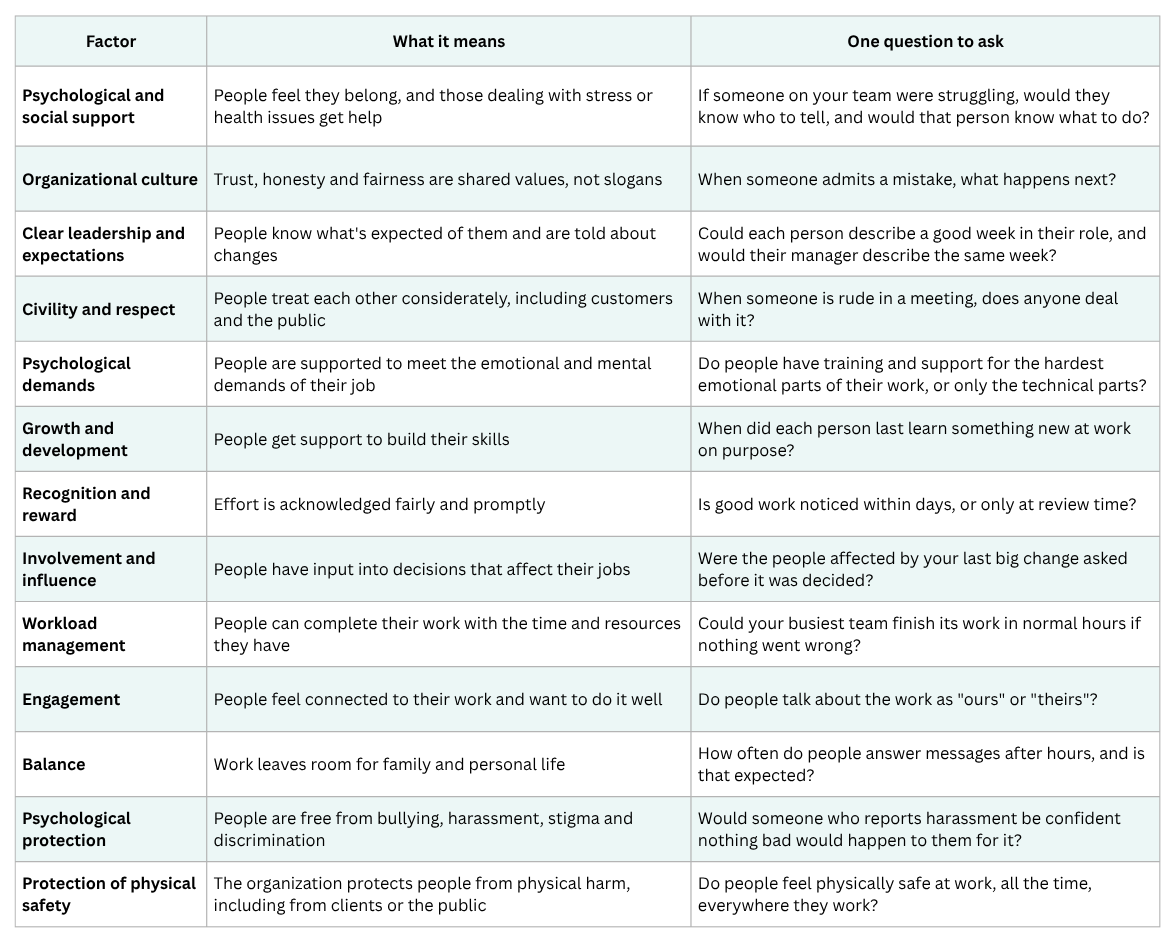
Canada's national standard for psychological health and safety, CSA Z1003, is built around 13 workplace factors. Most lists of them stop at the names, which leaves you nodding along without knowing where you stand. Each factor gets useful the moment you can ask one honest question about it. Here are all 13, with a question for each.
Where the factors come from
The 13 factors were developed by researchers at Simon Fraser University for Guarding Minds at Work, a free toolkit for employers. The National Standard of Canada for Psychological Health and Safety in the Workplace, CSA Z1003, adopted them in 2013. It's a voluntary standard, and the Mental Health Commission of Canada offers it as a free download.
You'll sometimes see a 14th item, "other chronic stressors as identified by employees." Guarding Minds at Work adds it as a reminder that your people may name stressors no list anticipates. The only way to find those is to ask.
The 13 factors
The names below follow the 2013 standard. The short descriptions paraphrase Guarding Minds at Work.
Answering honestly
Read each question and ask what you'd point to as evidence. "I think people feel supported" is an opinion. "Three people used the support process last quarter and all three said it helped" is evidence. If your honest answer to most questions is a guess, that's the finding, and it's a common one.
Two habits make the exercise worth doing. First, ask the questions of more than one person: a manager and a frontline worker will often give opposite answers, and the gap tells you something. Second, write the answers down with a date, then ask again in a few months. A factor that's slipping matters more than one that's merely weak.
You don't need to fix all 13 at once. Pick the two or three where your evidence is thinnest or the trend is worst, and start there. Our guide to running a psychosocial risk assessment walks through what to do next.
Download our psychosocial factors one pager.
________
PRA-Pulse™ turns this from a one time exercise into a habit. The free Risk Profile takes HR through a short set of questions every two weeks and shows how your organization trends over time, so you see where things are slipping before it shows up in turnover or leave.
See strain rise. Before it spikes. Start with Risk Profile, free PRA Pulse™ Workplace Risk Detection